Wednesday, June 22, 2011
Too simple, thus too terrible
In the story, "The Death of Ivan Ilych" by Leo Tolstoy, we notice a certain process that Ivan takes: taking the suggestions of society to shape his own world. In the story it mentions that "Ivan Ilych's life had been most simple and most ordinary and therefore most terrible.", which shows that he didn't take his own perspectives in order to decide what to do with his life, instead he went along with what society accepted, and thus took that course instead. Through his life we notice that he makes decisions that society seems to consider "simple and appropriate". We never fully hear him stating any real passions he wants to pursue, we just see his struggle is to be superior above everyone in order to be considered important and valuable in society.
I conclude this from the fact that he marries his wife, not from the mere and enjoyable interest of loving her, instead he does it due to the fact that society is charmed by their presence and how appropriate and perfect it seems to consider a wife in his time.
Also, later in the story he becomes very unhappy due to the change of plans that occur during his marriage. He ends of fighting frequently and never finding a way to pleasure his wife due to her unnecessary dissatisfactions with her life. Due to his actions, we find that his decisions were unnecessary due to the results of unhappiness that come up in his life. We also notice that when he fails to sustain a high ranking job, society considers him a failure. This failure brings a new low in Ivan, which sets him in a whole new depression of not being able to be accepted by society. Through his troubles and "failures", he is ranked and judged.
When Ivan notices that he isn't accepted anymore, he does everything in his power to have that luxury again. He finds connections and thus find his way up again. But this struggle shows him that he rather be at home. This doesn't really go well with his wife, who is only interested in living a wonderful life of importance. Therefore, his struggle isn't only to sustain his happiness, but the happiness of his ungrateful family, as well. Thus, at his end, he didn't live his life to sustain his own happiness; he lived his life in order to be accepted and to be loved. He also lived a life simple and ordinary in order to not cause any controversy with his surroundings. He could have chosen a different path, a satisfying path, but that would have gone against the wishes of his society. So he worked himself to death to provide pleasing results for the sake of living an ordinary life, which resulted in his horrible, true life he ended up having until the end.
Examining the world of The Yellow Wallpaper
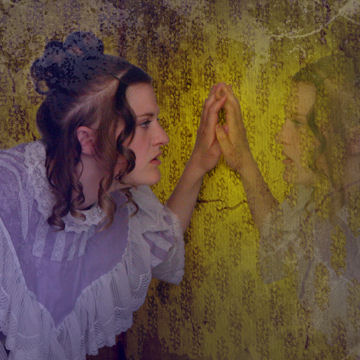
When reading "The Yellow Wallpaper" by Charlotte Gilman, I seemed to have entered a very perplexing mind. The narration that occurred in this story was first person, which gave us a detailed, yet very burying experience about what the narrator felt through out the whole story.
When I started reading the story, I visualized a woman that wasn't so ill minded, but just a woman that was depressed due to hormonal imbalances in her body. Her husband, who we know to be a physician, is taking her case and finding ways to improve her health. Due to his profession, he doesn't see his wife as a wife, but only a mere patient. Also, as the story carries on, we notice that he puts her in a "crazy-person" room which, as a result, keeps her away from the public eye as well as hidden from the people that know her husband really well. Therefore, by treating her as a patient as well as a type of problem that can hinder his reputation, we see the effects of these decisions affect the narrator greatly.
At first we see her emotional imbalanced and she goes on in great detail explaining how they (husband and family) have put her in a room that isn't well suited for her (of course it is not suited for her; she's not insane at that moment, just depressed!). She goes on complaining how the yellow wallpaper of her room is a very uncomfortable presence to her. She goes on in details how this wallpaper won't let her concentrate on anything else. In her descriptions, she explains that her complaining about the paper to her husband doesn't do her any good. She gets rejected of her wishes and is asked by her husband to rest, instead and deal with the yellow wallpaper.
We see that, due to her lack of control for herself and for her common rejections by her husband, she loses a bit of her own reality.
Through her personal writings and by witnessing not what the outside characters perceive, but what the narrator personally thinks, we get a personal insight to what is truly going on. We see that she is treated unfairly, and we also see how this unfairness affects her mind. We witness her go from slightly ill, to incredibly crazy in the end.
She focuses her time, as we read one, on that bewildering yellow paper. By being trapped and not having the means of communicating with the outside world, we see her world dwindling. This dwindling process makes her create her own little world inside that room to give her a slight view of reality, which is truths is just a mental problem that she is causing for herself. By making her own little world, she starts to see things. She complains about a woman that is creeping about her room and around the house, which gives an insight that it isn't' a woman, but her, possibly desiring to be like the woman. This gives the reader a kind of creepy insight because we see her process of insanity little by little, day by day. It is very frightening, as well as mystifying how her thoughts go from normal, to a bit out of touch with normality.
Through reading this story, I experience a sense of understanding. More than usual due to the process the narrator took. We have sympathy, yet a bit of creepiness due to how she ends up turning up in the end. The way this story was made, we get to have a certain connection; a personal bond with the narrator. We can understand well enough to know why things resulted because we saw many of the steps it took to get the character to her state. We also understand that nothing of what resulted was her fault. She was trapped, and by this resulted her to question reality to the point of loosing touch with it completely.
Monday, June 20, 2011
A Rose for Emily and creepiness on the side
In the short, fictional story, "A Rose for Emily" by William Faulkner, we meet in a past time, around the 1800s, with a town that is more than just curious. In the story, we find ourselves being narrated by the Jefferson town about Emily's past life as they make their way to her house to give their respects to her death. When it comes to time significance, the narration of time from the city seems to not be consecutively, but disordered. They go back from the past, to the present, then back to the past but in different times, making time seem not organized but a bit perplexing. As the story goes on, we seem to find that the distortion of time is very vital as we come to the end. With all of the mixing clues that appear by the present and past flashes, we come to a discovery of what led to the disappearance of Homer as well as why Emily lost the touch of reality. Therefore, time might have been a bit confusing at first, but in the end it all made sense. It gave the reader the fundamentals to understand why certain problems and results occurred.
As the analysis of the story went on, I discovered that time wasn't acceptable by Emily. Emily was raised and sheltered for so long, that time wasn't her responsibility. Due to her father's controlling problem as well as her extreme nurture, she found herself in a life where she was always protected, as well as always under someone else's control. When her farther passes away, we seem to find Emily in a bit of a problem. Even though time has taken her father, she can't comprehend or accept that he is gone. So, she keeps the corpse for three days while denying to the towns people that her farther is not dead, but still living. After her breakdown, we see that she doesn't due well with change that time causes, showing that she isn't capable of surviving dramatic changes in her life. Therefore, a huge theme that is witnessed is change versus tradition. Her "culture" was to do what her farther said was best. When that "culture" was taken away, she didn't know how to react, thus that led to her insanity of not letting go of her dead father.
As we keep reading, we see that her town is becoming more modern as new positions take over the city. Once again, due to Emily's new, uncontrollable freedom, she can't accept her outside improvements. She, in some part of the story, cannot fathom the existence of numbers being bolted to her house to give her an address. Of course, she can't accept it because there isn't a figure to help her understand. Also, her mind is so stuck in the past that she is completely ignorant to concentrate herself in a new, modern world.
When Homer Barron is introduced in the story, we seem to find a bit of hope for Emily to change for the better, but unfortunately, that isn't the case. Homer isn't a man to sit down and call himself a husband. He is more of a ladies man that can only handle manly jobs. But Emily, of course not equipped with the knowledge of how to handle men, finds herself buying arsenic and poisoning the man in order for him to not run away and in order to keep him for herself forever. Before poisoning him, we read on to find that she buys nice clothes for him and matching appliances as well as marital belongings, which don't really fit with the character of Homer. Later we find these belongings and appliances in the room Homer was found, which shows that Emily made her own world in that room. Time stood still while she laid next to the corpse of Homer in the same bed. She had full control this time, as well as control on time. While the town complained about Emily and the smell, she would lay happily merry next to her dead corpse. Also, as she laid with her corpse, time would persist, but she would stay constant to her traditions, ignoring what changes her surroundings adapted to.
As the analysis of the story went on, I discovered that time wasn't acceptable by Emily. Emily was raised and sheltered for so long, that time wasn't her responsibility. Due to her father's controlling problem as well as her extreme nurture, she found herself in a life where she was always protected, as well as always under someone else's control. When her farther passes away, we seem to find Emily in a bit of a problem. Even though time has taken her father, she can't comprehend or accept that he is gone. So, she keeps the corpse for three days while denying to the towns people that her farther is not dead, but still living. After her breakdown, we see that she doesn't due well with change that time causes, showing that she isn't capable of surviving dramatic changes in her life. Therefore, a huge theme that is witnessed is change versus tradition. Her "culture" was to do what her farther said was best. When that "culture" was taken away, she didn't know how to react, thus that led to her insanity of not letting go of her dead father.
As we keep reading, we see that her town is becoming more modern as new positions take over the city. Once again, due to Emily's new, uncontrollable freedom, she can't accept her outside improvements. She, in some part of the story, cannot fathom the existence of numbers being bolted to her house to give her an address. Of course, she can't accept it because there isn't a figure to help her understand. Also, her mind is so stuck in the past that she is completely ignorant to concentrate herself in a new, modern world.
When Homer Barron is introduced in the story, we seem to find a bit of hope for Emily to change for the better, but unfortunately, that isn't the case. Homer isn't a man to sit down and call himself a husband. He is more of a ladies man that can only handle manly jobs. But Emily, of course not equipped with the knowledge of how to handle men, finds herself buying arsenic and poisoning the man in order for him to not run away and in order to keep him for herself forever. Before poisoning him, we read on to find that she buys nice clothes for him and matching appliances as well as marital belongings, which don't really fit with the character of Homer. Later we find these belongings and appliances in the room Homer was found, which shows that Emily made her own world in that room. Time stood still while she laid next to the corpse of Homer in the same bed. She had full control this time, as well as control on time. While the town complained about Emily and the smell, she would lay happily merry next to her dead corpse. Also, as she laid with her corpse, time would persist, but she would stay constant to her traditions, ignoring what changes her surroundings adapted to.
Thursday, June 16, 2011
Jon Stewart? Let's leave it there...
In the video,"CNN Leaves it There", Jon Stewart uncovers many of the fallacies that CNN tends to make continuously during their airings. Through their fallacies, I learned that many of their errors resulted from poor analysis techniques the announcers used to present their findings on television.
Through Stewarts criticism, he makes very clear and logical points that prove CNN is full of mistakes when it comes down to their "statistical data". Many of their numerical values that they used to prove their points become somewhat questionable. Stewart points out how and where on earth do these announcers claim their data? The announcers use a type of weak critical thinking to present their ideas. They use big numbers and "important words" to provide a very dramatic finding to their audience, but when their analysis is looked at and listened to more carefully, we see the ridiculousness of their findings. Many of the examples Stewart starts off with is how the announcers mention that 100-200 billion dollars can be saved if malpractice is prevented. When a careful calculation is made of the real savings, only 11 billion can be saved, realistically. Truly, CNN was off by more than they could ever bargain for. Unfortunately, another male announcer goes on to mention unrealistic data by saying that only 5 to 10 million are uninsured in America. Truly, numbers can't jump halves like that when presenting data that important.
Many of the announcers, as Stewart puts it, seem to be pulling their data, not from reliable, recognizable sources, but only from their heads. By pulling up tricks, they create a type of slippery slope fallacy, which leads to a series of "horrible" outcomes by stating problem after problem, without mentioning possible interferences that can lighten up the problems. By not proclaiming any possible ways to come out of the problems, they create a type of panic within the audience that leads the listeners to believe what they are stating.
As the video goes on, Stewart makes another claim on how CNN can't take the heat of being discovered. Put simply, when they can't explain something or don't have the means of showing proof for their obvious lies, they just simply run away from it by saying "Let's leave it there" and, well, that's it. They never come back to the topic; they just merely run away from it, avoiding the embarrassment of not being able to win whatever they were accounted for. Unfortunately, their running away and fake data just proves how horrible television can be when it comes to critical thinking.
This is possibly one of the most fake ways of using critical thinking. As Stewart puts it, their findings are just full of unnecessary lies. From this I learned that critical thinking can sometimes be misleading if not enough effort is made in claiming realistic arguments. A real argument is to be analyzed carefully by having logical sources as well as intellectual presentations that support your argument. A process of having the right tools at hand as well as showing your audience that you know you are an expert on your claim gives your critical thinking strength to show that you know what you are talking about. If your data is questionable an a bit hilarious due to its ludicrousness, then, simply put, let's not leave it there, lets just state that it's just horrible analysis.
Subscribe to:
Comments (Atom)